Recording it should not be the second workout. A completed workout does not need to become an evening of admin. If you remember what you did, tell ChatGPT or Claude and ask Nexus to save it. Meals and training can live in the same journal, reached from the same conversation.
Connect Nexus once in ChatGPT or Claude. After that, use the chat you already open on your phone. There is no separate Nexus fitness app to download.
Tell it the sets you actually did
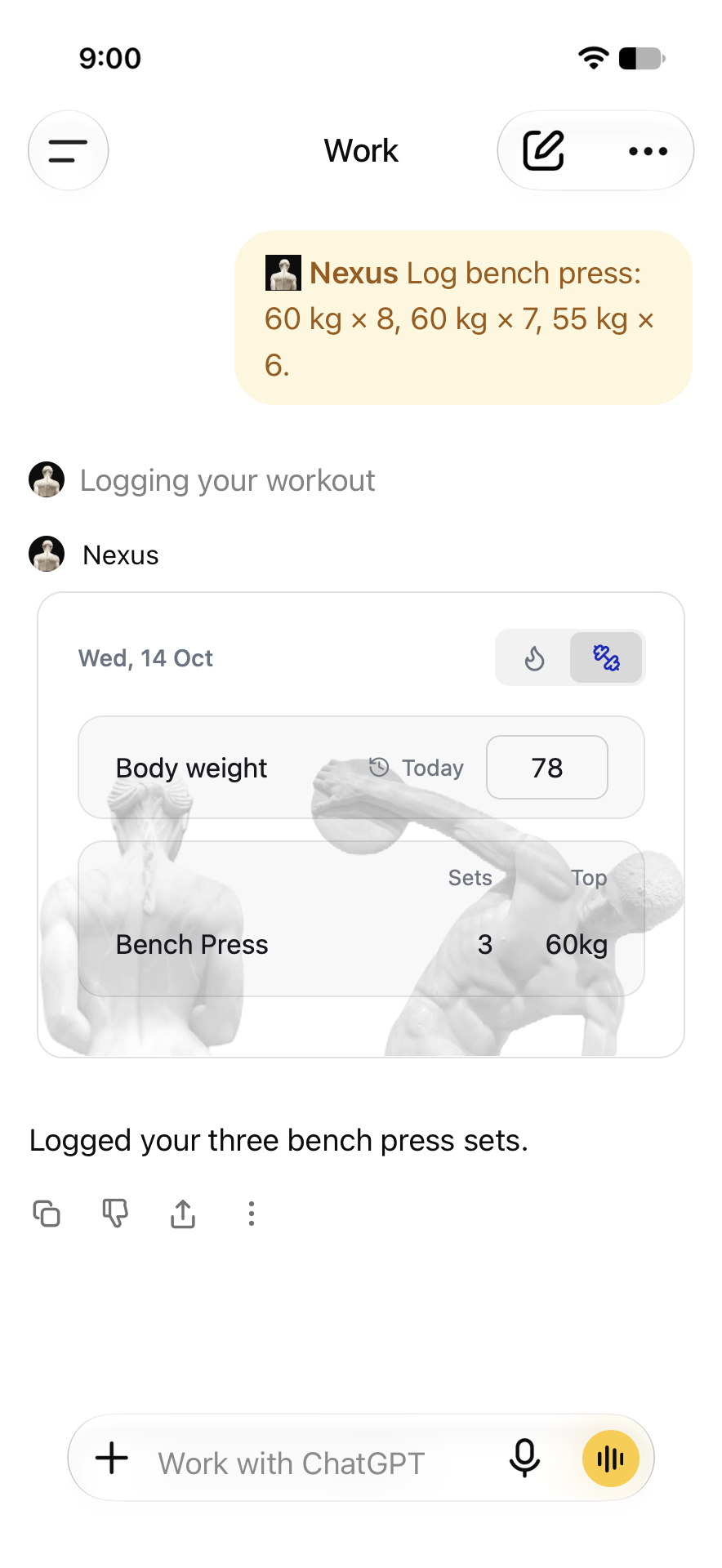
Nexus, log bench press today: 60 kg for 8 reps, 60 kg for 7, and 55 kg for 6.
Exercise, weight, and repetitions are the useful details. Different sets can have different numbers. You do not need to make them all fit “3 × 8” if that is not what happened. The assistant turns your message into structured sets for Nexus.
Say whether your weights are kilograms or pounds. For dumbbells, explain whether you mean each dumbbell or the combined load. For assisted movements, explicitly say “assistance” so the number is not casually treated as added weight.
Use your voice after the set
The microphone in the ChatGPT composer lets you dictate a message. Review the transcription before sending—particularly the exercise name, unit, and numbers.
Nexus, log bench press today: 60 kilograms for 8 reps, 60 for 7, and 55 for 6.
You can give the whole session in one message or log an exercise as you go. Keep the request explicit: “log this in Nexus.” A discussion about tomorrow’s workout should not become a record of training you have not done.
Keep cardio in the journal too
Nexus, log a 5 km run today. It took 27 minutes.
Distance and duration tell a different story from sets and reps. Give the details you know instead of inventing a load or repetition count to make cardio resemble a lift. The same journal can hold both kinds of training.
Check the saved result
Nexus, show the workouts I logged today, including every set.
Read the saved exercise names and sets. This is the boundary that matters: an encouraging reply from the assistant is not the same thing as a persisted workout. The returned journal should match what you performed.
If you return in a different conversation, ask Nexus to retrieve the date or exercise. You do not have to rely on the assistant reconstructing the session from conversational memory.
Fix one set, not the whole day
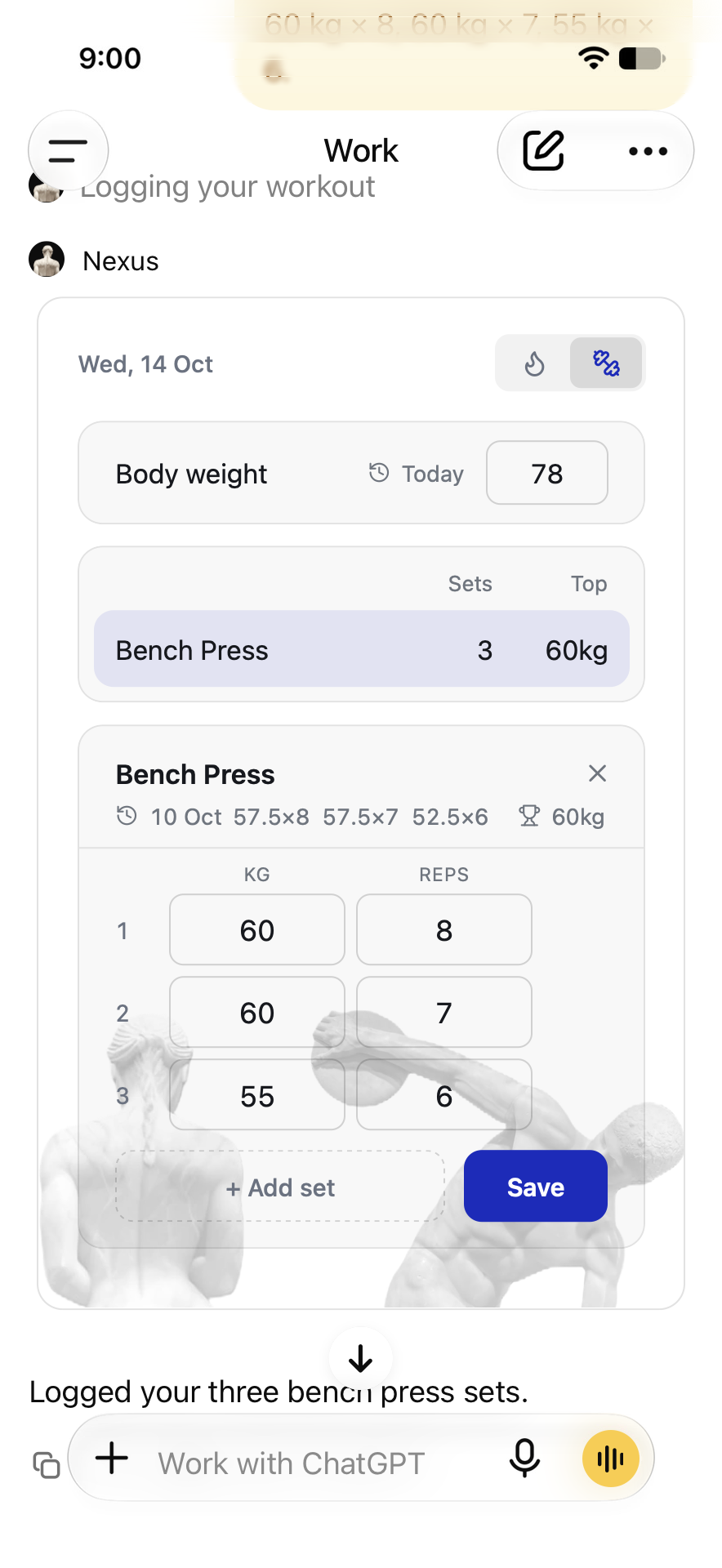
In the bench press I just logged, change the first set to 9 reps. Leave the other two sets as they are.
A correction should update the existing record. Make clear which exercise and set you mean. If there are two bench sessions on the same day, identify the one you are correcting before asking the assistant to change it.
The benefit is ordinary but useful: you can notice a mistake and say what changed instead of re-entering the session from scratch.
Let history answer the next question
Nexus, what did I do for bench press last time? Show the sets and weights.
A saved log becomes useful when you need it again. Ask about the last session, a date range, or an exercise. Use the actual history as the starting point for your next plan rather than asking for an unrelated generic workout every time.
For a session you want to follow set by set, use the workout-session guide. Planning a session and logging a completed workout are separate actions.
One less place to maintain
If you already talk to an assistant about training, Nexus gives that conversation a durable journal. You can describe the session in your own words, check its saved form, and retrieve it later. You still have to do the workout; recording it should not be the second workout.
Connect Nexus and try one exercise you actually performed.